With its iconic ivy-covered walls and hand-turned scoreboard, Wrigley Field is one of the most recognizable ballparks in the country. It primarily serves as home to the Chicago Cubs but has also become a destination for some of the top musical acts in the world as they pass through the Windy City. Plan your next trip to this historic venue with TicketSmarter’s Wrigley Field Guide.
Quick History of Wrigley Field
Chicago’s Wrigley Field was built in 1914 and is Major League Baseball’s second-oldest stadium. The oldest is Fenway Park where the Boston Red Sox play. The venue was originally known as Weeghman Park and belonged to Charles H. Weeghman. It had an original seating capacity of 14,000 and cost an estimated $250,000 to build.
The first professional baseball game was held there on April 23, 1914, and featured the Chicago Whales of the Federal League. The Chi-Feds won the championship in 1915 but the league folded later that year. Weeghman eventually joined forces with chewing gum magnate William Wrigley Jr. to purchase the Chicago Cubs and move them into the park. In 1926, the ballpark was renamed Wrigley Field.
Wrigley Field underwent a multi-year restoration and expansion project following the 2014 season called the 1060 Project. Changes included structural upgrades, updated outfield signage and video boards, and enhanced connectivity throughout the venue. In 2020, Wrigley Field became a National Historic Landmark.
Wrigley Field hosted its first major concert in 2005 with a two-night performance by Jimmy Buffett. Since then, the ballpark has seen acts like Billy Joel and Elton John, Dave Matthew Band, Brad Paisley and Bruce Springsteen & The E Street Band take the stage.
Where is Wrigley Field?
Wrigley Field is located at 1060 W. Addison St. on Chicago’s North Side in the Lakeview community. More precisely, the ballpark is in the Wrigleyville neighborhood where you will find rows of low-rise brick buildings often adorned with bleachers on top where residents can watch a baseball game or concert from afar. These are often referred to as Wrigley Rooftops. Wrigleyville is also home to several sports bars like Sluggers, Murphy’s Bleachers, The Cubby Bear and Sports Corner where you can grab a cold one before or after the game.
Wrigley Field Design
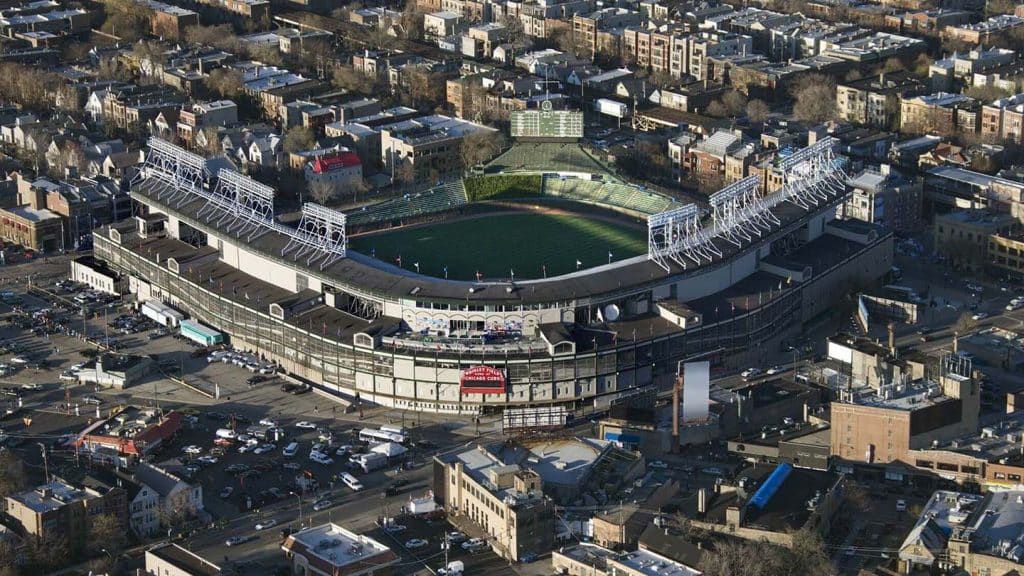
Wrigley Field features a jewel box ballpark design that was popular in the early 1900s, especially in downtown settings. There are only two jewel box ballparks still in use today, Wrigley Field and Fenway Park. Others like Comiskey Park in Chicago, Ebbets Field in Brooklyn and Polo Grounds in Manhattan have since been converted into public housing or parking for newer stadiums.
One signature feature of the jewel box ballpark is its odd outfield dimensions created by the restrictions of building within a city block. Wrigley Field measures 400 feet to center field, 355 to left and 353 to right.
Avid baseball fans will want to stop by the Cubs Hall of Fame in the Left Field Budweiser Bleacher concourse to see plaques recognizing the franchise’s biggest contributors. Statues commemorating Hall of Fame players Earnie Banks, Billy Williams, Ron Santo and Fergie Jenkins can be found around the stadium. There is also a Harry Caray statue honoring the legendary Cubs broadcaster.
There are six main entrances to Wrigley Field but the Instagram-worthy marquee sign is hung above the Marquee Gate at the intersection of Addison and Clark. Gates open 90 minutes before first pitch for most games and up to two hours before for special occasions.
Wrigley Field Seating Chart
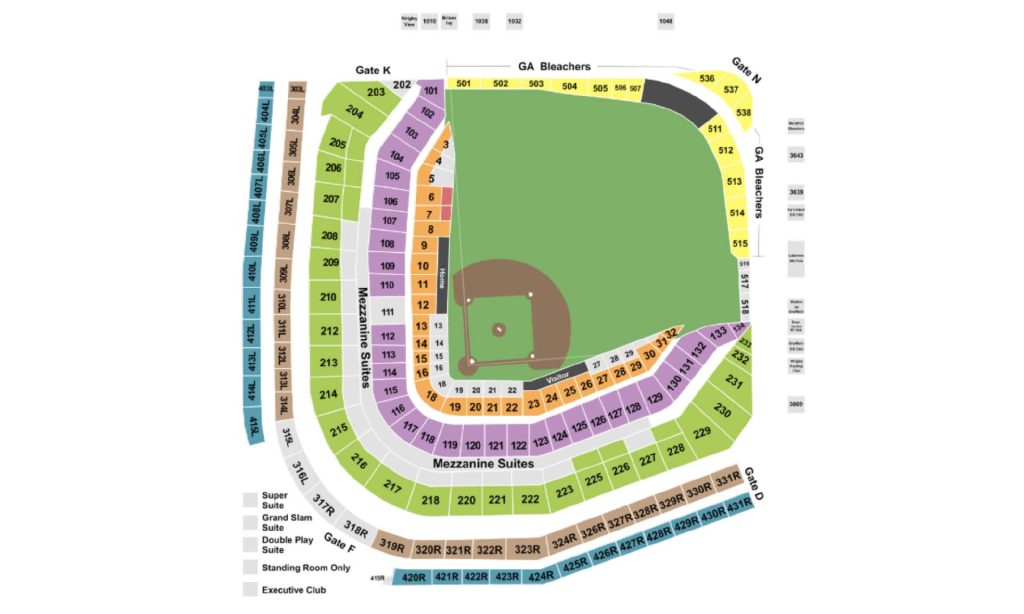
This stadium can hold a capacity crowd of 41,649 with three main seating options: lower level, upper level and outfield bleachers. The Cubs’ dugout is located down the third base line and the visitors’ dugout sits on the first base line. You can use TicketSmarter’s interactive seating map to find the perfect Wrigley Field tickets.
Lower Level
The lower level consists of club box seats, field box seats and terrace seats. Club box seats will get you closest to the field. This option includes sections 3–32 which wrap around the baselines. Field box seats are found in sections 101–134 and are the next best option in the main seating area. The 200 level is the terrace and includes sections 202 through 232. Netting extends to the outfield edge of each dugout for fan safety.
Helpful details:
- The Cubs dugout sits in front of sections 12–15; visitors in front of 27–32.
- Rows 1–2 of the 200 level are close to the walkway, so foot traffic can briefly enter your view.
- For day games, the third base side tends to shade earlier. Shaded seats can feel cold in spring and fall.
Upper Level
The upper level at Wrigley Field includes the 300 and 400 sections with upper deck box seats and upper deck reserved seats. These still offer a great view, but often come with a slightly lower price tag. Upper Deck box seats are at the front of the upper deck in sections 303–314 and 319–331 for stronger sightlines.
Outfield Seats
For a different perspective, Wrigley Field’s Budweiser Bleachers are a fun way to see a game. These are positioned in the outfield facing toward the batter rather than the traditional view from behind the batter. If you plan to sit here, you will want to arrive early as these general admission seats are filled on a first-come, first-serve basis during the regular season. The bleachers are now numbered in the 500s and are split into lower and upper areas, with the best chance to catch a home run.
Newer premium options above the batter’s eye in center field offer elevated views, indoor and outdoor patios, and upgraded food and drink selections.
Obstructed View Seats
One important thing to keep in mind when you are choosing your Wrigley Field seats is that several of them have obstructed views due to the support beams that hold the upper deck. This primarily affects the terrace and 400 level though only one or two seats per row are directly obstructed. Use the Cubs 3D Virtual Venue or TicketSmarter’s interactive map to preview sightlines, and check your ticket notes for any obstructed view flags.
Getting to Wrigley Field
There are several options for getting to Wrigley Field ranging from public transportation to rideshare and bikes. You can also drive and park at Wrigley Field, which we will explore more below. Chicago Transit Authority or CTA has Red Line, Yellow Line and Purple Line Express trains that stop at Addison, Howard and Sheridan, respectively. CTA buses #8, #22, #152 and #80 will also take you to the ballpark. Busses 22 and 152 are generally preferred as they stop at the intersection of Clark & Addison.
If you opt for rideshare, there are designated pick-up locations on Addison Street between Broadway and Halsted Street, and at Irving Park Road between Clark Street and Seminary Avenue.
The Cubs offer free bike valet service during their home games. Riders can check their bikes near the main entrance of the CTA Red Line stop on Addison Street up to three hours before a game.
Extra transit tips:
- The CTA Red Line’s Addison Station is the most direct stop for Wrigley. Postgame trains can be crowded, so allow extra time or leave a bit early.
- From the suburbs, the Pace Wrigley Field Express and CTA route 154 have operated on select dates. Check schedules before you go.
Parking Near Wrigley Field
If you choose to drive yourself, it would be wise to review your options for parking near Wrigley Field before you go. The Prius Lot and Highlander Lot are located closest to the stadium between Clifton and Seminary Avenues on Waveland. The RAV4 Lot, Corolla Lot, Camry Lot and Irving Park Lot are all located a few blocks away. All of these options are cashless.
Accessible parking is available in the Toyota Camry Lot at 1126 W. Grace Street. These spots are filled on a first-come, first-serve basis but can be reserved through the Wrigley Field Ticket Office. A golf cart shuttle runs between the Camry Lot and the Horizon Left Field Gate. Fans with ADA needs can also use a free shuttle service that drops off near the entrances.
Accessibility Accommodations
Accessible seating is available throughout the park for guests with mobility disabilities and up to three companions. Wrigley Field also offers Assistive Listening Devices free of charge and has captioning available for the public address system. Interpreters are available for all concerts at Wrigley Field and sensory kits prepared by KultureCity can be borrowed from Fan Services. The Cubs’ official Accessibility Guide confirms accessible parking at the Toyota Camry Lot (reserveable through the ticket office), complimentary accessible golf-cart shuttles (first-come, first-served), accessible seating with up to three companion seats, assistive listening devices, captioning, interpreters for concerts, KultureCity sensory kits and a sensory room added for the 2024 season. (mlb.com)
Fans are encouraged to contact the Wrigley Field Ticket Office to coordinate ticket purchasing, parking and any other accessibility accommodations. The accessible golf-cart shuttle between the Toyota Camry Lot and the Left Field Gate operates on a first-come, first-served basis.
Food & Beverage Services
Throughout the concourses, you will find a bunch of Wrigley Field food and beverage options ranging from ballpark favorites like nachos, pretzels and popcorn to elevated entrees like Chicago-style hot dogs and Italian beef sandwiches. There are also gluten-free, Kosher, vegetarian and vegan options available. Gluten-free burgers, hot dogs and beer are offered at select stands.
Several different alcoholic beverages available for purchase including Chicago’s own brews from Goose Island Beer Company like the 312 Shandy, Neon Bear Hug and 312 Urban Wheat Ale.
FAQ: Common Wrigley Field Questions
Can I bring a bag to Wrigley Field?
Bags that are smaller than 16 x 16 x 8 are permitted inside the stadium. This includes wallets, purses, drawstring bags, soft-sided coolers and other bags. Families with young children may also bring diaper bags. Wrigley Field does not offer bag or luggage storage. Backpacks and hard coolers are not allowed except for medical or baby needs.
Is there tailgating at Wrigley Field?
There is no tailgating allowed at any of the Cubs-operated parking lots.
Can I bring in my camera?
Visitors are welcome to bring still and video cameras to the ballpark but cannot have tripods in the seating areas. All bags are subject to inspection at the gate.
Are there Wrigley Field tours?
Yes. There are tours available for fans who want to get a behind-the-scenes look at this iconic ballpark. Tours last around between 75 and 90 minutes depending on the day. Gameday tours will include stops in the seating bowl, bleachers, upper deck and field. Non-gameday tours will also visit the outfield ivy, press box, visitor clubhouse and dugout. For more information, visit the Wrigley Field Tours page.
How do I choose the best seating section for sightlines and price?
Start by deciding between lower level action and upper level value. Upper Deck box seats at the front of the 300 level balance price and view well, while terrace 200 seats can be impacted by support poles. Use TicketSmarter’s interactive seating map to compare listings and check notes for any obstruction flags. For day games, seats on the third base side tend to shade earlier.
Budweiser Bleachers or lower level: what are the pros and cons?
Bleachers are general admission and create a classic, social vibe with a great chance at a home run ball, but they do not guarantee a specific seat and fill quickly. Lower level seats provide assigned locations, closer views of infield play and easier access for families. If you love mingling and outfield views, try the bleachers. If you want dugout angles or guaranteed rows, choose lower level.
What are the obstructed view issues at Wrigley Field?
Support beams can affect some terrace 200 and upper 400 seats. Usually only one or two seats per row are directly blocked, but partial obstructions are possible. Always review ticket notes. If possible, preview sightlines on a 3D venue map before you purchase on TicketSmarter.
Which train stops closest to Wrigley Field?
The CTA Red Line’s Addison Station is the closest. CTA buses 22 and 152 stop at Clark and Addison. After games, lines are long, so add buffer time. Select dates may feature the Pace Wrigley Field Express and route 154 for suburban service.
Is accessible seating and shuttle service available?
Yes. Accessible seating is available throughout the park with up to three companion seats. An accessible golf-cart shuttle runs between the Toyota Camry Lot and the Left Field Gate on a first-come basis. Contact the ticket office in advance to arrange parking and accommodations. You can also browse accessible listings on TicketSmarter’s Wrigley Field tickets page.
Where should I park if I need ADA access?
Accessible parking is located in the Toyota Camry Lot at 1126 W. Grace Street, subject to availability. A golf-cart shuttle connects that lot to the Left Field Gate. Some remote lots may offer shuttle service on select dates, so check availability in advance.
What are the food and dietary options inside Wrigley Field?
You will find classic items and specialty stands that include gluten-free burgers, hot dogs and beer. Vegetarian and vegan options are available, and select kiosks offer Kosher products on certain dates. Ask your nearest stand or Guest Services for current locations.
How early do gates open and where is the marquee entrance?
Gates typically open 90 minutes before first pitch, and up to two hours for select events. The famous red marquee is above the Marquee Gate at Addison and Clark, which is a perfect pregame photo stop.
Does Wrigley Field have will call or accept ticket refunds?
Will call is not available. Have your mobile tickets ready before arrival. The Cubs do not offer refunds or exchanges, so review your order carefully. When you buy on TicketSmarter, you are covered by our 100 percent TicketSmarter Guarantee.
Get Wrigley Field Tickets
Whether you are watching the Chicago Cubs battle for a pennant or you are rocking with a band like Guns N’ Roses, Wrigley Field tickets from TicketSmarter will help secure your seat for the biggest events of the year. You can also explore dates on our Wrigley Field venue page or jump to Chicago Cubs tickets. For more trip planning tips, see our expanded Wrigley Field event guide. If you are coming in from out of town, make sure to check HotelPlanner for exclusive Chicago travel deals and remember to keep this Wrigley Field guide handy for any questions that arise. Buy with confidence using the TicketSmarter Guarantee.
Author: TicketSmarter Insider Team
Updated: January 21, 2025
The TicketSmarter Insider Team covers stadium guides, seating tips and event planning to help you choose the right seats and get to the venue with ease. Our editors collaborate with local experts and verify policies and amenities before publication.